
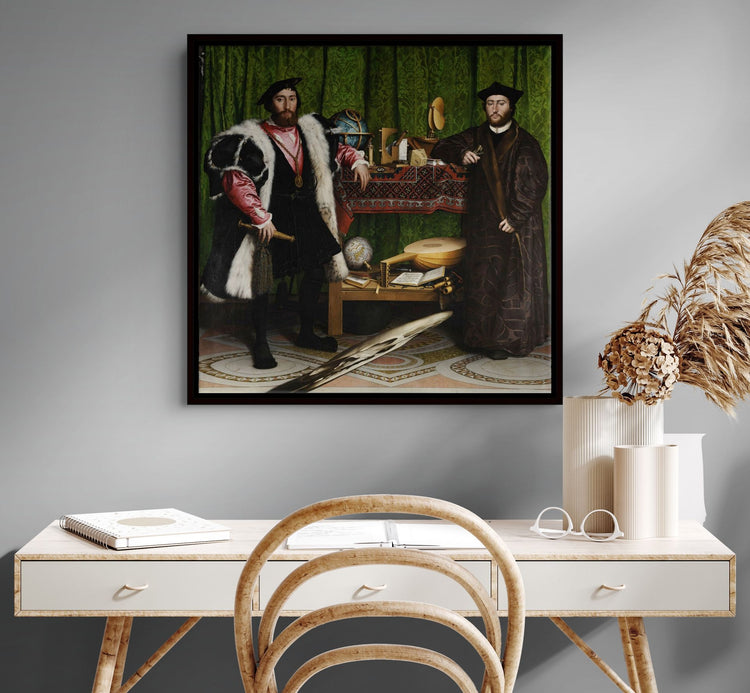
The Ambassadors by Hans Holbein the Younger | 1533
- Regular price
- $55.00
- Sale price
- $55.00
- Regular price
Shipping Information
We accept returns. You can return unopened items in the original packaging within 30 days of your purchase with receipt or proof of purchase. If 30 days or more have passed since your purchase, we cannot offer you a refund or an exchange.
Upon receipt of the returned item, we will fully examine it and notify you via email, within a reasonable period of time, whether you are entitled to a return. If you are entitled to a return, we will refund your purchase price and a credit will automatically be applied to your original method of payment.
Only regular priced items may be refunded. Sale items are non-refundable.
Shipping Information
We accept returns. You can return unopened items in the original packaging within 30 days of your purchase with receipt or proof of purchase. If 30 days or more have passed since your purchase, we cannot offer you a refund or an exchange.
Upon receipt of the returned item, we will fully examine it and notify you via email, within a reasonable period of time, whether you are entitled to a return. If you are entitled to a return, we will refund your purchase price and a credit will automatically be applied to your original method of payment.
Only regular priced items may be refunded. Sale items are non-refundable.
Couldn't load pickup availability


Welcome to VisaroArt!
We are two friends who share a passion for art and the stories behind great masterpieces. Through our YouTube channel, Visaro, and our collection of high-quality art prints and canvases, we hope to bring the beauty and history of art closer to everyone.
Two friends sharing their love for art.
Description
More
Less
The Ambassadors is a 1533 painting by Hans Holbein the Younger. Also known as Jean de Dinteville and Georges de Selve, after the two people it portrays, it was created in the Tudor period, in the same year Elizabeth I was born. Franny Moyle speculates that Elizabeth's mother, Anne Boleyn, then Queen of England, might have commissioned it as a gift for Jean de Dinteville, the French ambassador, portrayed on the left. De Selve was a Catholic bishop.
As well as being a double portrait, the painting contains a still life of meticulously rendered objects, the meaning of which is the cause of much debate. An array of expensive scientific objects, related to knowing the time and the cosmos are prominently displayed. Several refer to Rome, the seat of the Pope. A second shelf of objects shows a lute with a broken string, a symbol of discord, next to a hymnal composed by Martin Luther.
It incorporates one of the best-known examples of anamorphosis in painting. While most scholars have taken the view that the painting should be viewed side on to see the skull, others believe a glass tube was used to see the skull head on. Either way, death is both prominent and obscured until discovered. Less easily spotted is a carving of Jesus on a crucifix, half hidden behind a curtain at the top left.
The Ambassadors has been part of London's National Gallery collection since its purchase in 1890. It was extensively restored in 1997, leading to criticism, in particular that the skull's dimensions had been changed.
Shipping information
More
Less
We provide Worldwide Shipping with tracking to most locations around the world. We operate a global production network, which allows us to produce and deliver orders locally for free. Our production facilities are located in the US, Canada, UK, Spain, and Australia.
Shipping times around the world vary based on your location. Here are our estimated delivery times from the day of purchase:
- US, Canada: 7-10 business days
- Continental US, Alaska and Hawaii: 10-14 business days
- UK: 7-10 business days
- Australia: 7-10 business days
- EU: 10-14 business days
- Rest of the World: 14 business days
Above times are estimates, and include handling time to prepare your order. Business days exclude weekends and holidays. Please refer to the delivery time specific to your shipping address that is presented during the checkout.
We currently ship with the following global shipping partners: FedEx, UPS, DHL, GLS, Canada Post, Royal Mail, Aramex, and Australia Post.
Description
The Ambassadors is a 1533 painting by Hans Holbein the Younger. Also known as Jean de Dinteville and Georges de Selve, after the two people it portrays, it was created in the Tudor period, in the same year Elizabeth I was born. Franny Moyle speculates that Elizabeth's mother, Anne Boleyn, then Queen of England, might have commissioned it as a gift for Jean de Dinteville, the French ambassador, portrayed on the left. De Selve was a Catholic bishop.
As well as being a double portrait, the painting contains a still life of meticulously rendered objects, the meaning of which is the cause of much debate. An array of expensive scientific objects, related to knowing the time and the cosmos are prominently displayed. Several refer to Rome, the seat of the Pope. A second shelf of objects shows a lute with a broken string, a symbol of discord, next to a hymnal composed by Martin Luther.
It incorporates one of the best-known examples of anamorphosis in painting. While most scholars have taken the view that the painting should be viewed side on to see the skull, others believe a glass tube was used to see the skull head on. Either way, death is both prominent and obscured until discovered. Less easily spotted is a carving of Jesus on a crucifix, half hidden behind a curtain at the top left.
The Ambassadors has been part of London's National Gallery collection since its purchase in 1890. It was extensively restored in 1997, leading to criticism, in particular that the skull's dimensions had been changed.
Shipping information
We provide Worldwide Shipping with tracking to most locations around the world. We operate a global production network, which allows us to produce and deliver orders locally for free. Our production facilities are located in the US, Canada, UK, Spain, and Australia.
Shipping times around the world vary based on your location. Here are our estimated delivery times from the day of purchase:
- US, Canada: 7-10 business days
- Continental US, Alaska and Hawaii: 10-14 business days
- UK: 7-10 business days
- Australia: 7-10 business days
- EU: 10-14 business days
- Rest of the World: 14 business days
Above times are estimates, and include handling time to prepare your order. Business days exclude weekends and holidays. Please refer to the delivery time specific to your shipping address that is presented during the checkout.
We currently ship with the following global shipping partners: FedEx, UPS, DHL, GLS, Canada Post, Royal Mail, Aramex, and Australia Post.

You May Also Like